- job ticket
- section
- ai writing
- slug
- ai-words-and-phrases-to-mark
- checked
- editor
- Nora Feld
AI Buzzwords and Stock Phrases: What to Mark in a Draft and Why
Delves, underscore, showcase, commendable: researchers have counted the jump. A word on the list is a reason to look closely, and the margin note matters more than the mark.
in short
AI buzzwords are words that language models use far more often than human writers, such as delves, underscore, showcase, pivotal, intricate, meticulous and commendable. Corpus studies of PubMed abstracts, arXiv papers and conference peer reviews measured sharp rises after 2022. Mark them when they cluster or carry no meaning, and replace them with plain, specific wording.
AI buzzwords are the words chatbots reach for more often than people do: delves, underscore, showcase, pivotal, intricate, commendable. This is not only a hunch. Researchers have measured the jump in millions of scientific abstracts, hundreds of thousands of papers and thousands of peer reviews. But a word on a list is a reason to look, not a verdict. This page sets out where the lists come from, a table of the words and stock phrases worth marking with the study behind each, a worked example, and the plain wording to write in the margin instead.
Where the word lists come from
A buzzword is a word doing the job of a fact that is not there.
Three studies did most of the counting. Each compared text written after chatbots became widely available with text written before, and each found a set of words whose frequency jumped in a way no news event explains.
Kobak and colleagues took more than 15 million biomedical abstracts indexed by PubMed from 2010 to 2024. For each word they compared its 2024 frequency with the frequency expected from the 2021 and 2022 data, the same method that picks up words like covid during the pandemic. They found 379 excess style words in 2024; 66% were verbs and 14% adjectives. From those words they estimated that at least 13.5% of 2024 abstracts were processed with language models, a lower bound that reached 40% in some subgroups.
Liang and colleagues analyzed 950,965 papers posted to arXiv and bioRxiv or published in Nature portfolio journals between January 2020 and February 2024. The four words most disproportionately used by models compared with humans, by log odds ratio, were realm, intricate, showcasing and pivotal. Their estimated share of model-modified content in computer science abstracts reached 17.5% by February 2024, against 4.9% in mathematics abstracts.
A second study by Liang and colleagues looked at peer reviews for four AI conferences: ICLR 2024, NeurIPS 2023, CoRL 2023 and EMNLP 2023. In ICLR 2024 reviews, the probability of a sentence containing commendable rose 9.8-fold, meticulous 34.7-fold and intricate 11.2-fold. They estimated that 6.5% to 16.9% of review text could have been substantially modified by a model, beyond spelling fixes or minor edits.
| Study | What was counted | Words that stood out | Headline figure |
|---|---|---|---|
| Kobak et al. (2024, revised 2025) | 15 million+ PubMed abstracts, 2010 to 2024 | delves, underscores, showcasing, potential, findings, crucial | At least 13.5% of 2024 abstracts processed with models |
| Liang et al., scientific papers (2024) | 950,965 papers on arXiv, bioRxiv and in Nature portfolio journals | realm, intricate, showcasing, pivotal | Up to 17.5% model-modified content in computer science abstracts |
| Liang et al., peer reviews (2024) | Reviews for ICLR 2024, NeurIPS 2023, CoRL 2023, EMNLP 2023 | commendable, meticulous, intricate | 6.5% to 16.9% of review text possibly substantially modified |
Note what all three share: they estimate the share of a whole body of text. Kobak's team calls its figure a lower bound, and the Liang papers stress that their estimates work at the level of the corpus rather than the individual document.
The AI buzzwords table: what to mark and why
The table gives each word, the evidence for it, and what to write in the margin. The figures in the second column are the ones each study reports: Kobak's frequency ratios against the expected 2024 rate, and the fold increases Liang's team found in ICLR 2024 review sentences.
| Word | Evidence | What to mark | Margin note |
|---|---|---|---|
| delves, delves, delving | 28 times the expected 2024 rate in PubMed abstracts (Kobak) | Every use | look at, study, or cut the clause |
| underscore, underscores | 13.8 times the expected rate (Kobak) | The verb | shows, or state the result |
| showcase, showcasing | 10.7 times the expected rate (Kobak); top four in Liang's paper study | The verb | shows; name what was shown |
| pivotal | Top four by log odds in Liang's paper study | Every use | Say what it affects and how much |
| realm | Top four in Liang's paper study | Every use | field, area, or name the field |
| intricate, intricacies | Top four in Liang's paper study; 11.2-fold in ICLR 2024 reviews | When nothing is described | Name the parts that make it complex |
| meticulous, meticulously | 34.7-fold in ICLR 2024 reviews | Praise with no detail | Describe the method instead |
| commendable | 9.8-fold in ICLR 2024 reviews | Praise with no detail | Say what is good and why |
| potential, findings, crucial | Common words with large excess gaps; potential appeared in 5.2 points more abstracts than expected (Kobak) | Only when stacked | Usually keep; cut when two share a sentence |
| additionally, notably, comprehensive, particularly | In Kobak's set of ten common marker words | Sentence-opening Additionally | Also, or nothing |
| tapestry, testament, landscape, vibrant, fostering | Listed as words to watch in Wikipedia's cleanup guide | Abstract uses | Cut, or replace with the concrete thing |
The common words deserve care. Kobak's team built one of its estimates from ten frequent words, including across, within, insights and crucial, because frequent words can show a population shift. A shift in millions of abstracts does not make any one within suspicious. Mark the rare, showy words; leave the ordinary ones unless they pile up.
Stock phrases worth a mark
Phrases are often stronger signs than single words, because they bring a sentence shape along with them. Wikipedia's field guide to AI writing groups them by the job they do. The groups below follow its words-to-watch lists.
- Significance claims: stands as, serves as, is a testament to, plays a pivotal role, setting the stage for, marks a shift, evolving landscape. Mark the phrase and ask what fact it stands in for.
- Promotional tone: boasts a, nestled in the heart of, rich, vibrant, groundbreaking, renowned, diverse array. Mark it in any text meant to be neutral.
- Vague authority: experts argue, observers have cited, industry reports. Underline it; it needs a named source or it goes.
- Trailing analysis: highlighting ..., underscoring ..., reflecting ..., contributing to ... at the end of a sentence. Mark the clause; it usually restates the sentence.
- Disclaimers and chat residue: it is important to note, I hope this helps, Certainly!, let me know. Mark and cut. The last three were written to a chat user, not a reader.
For the sentence shapes that travel with these phrases, such as lists of three and not just ... but, see how to highlight AI-sounding sentences. Punctuation has its own page: what the em dash does and does not prove.
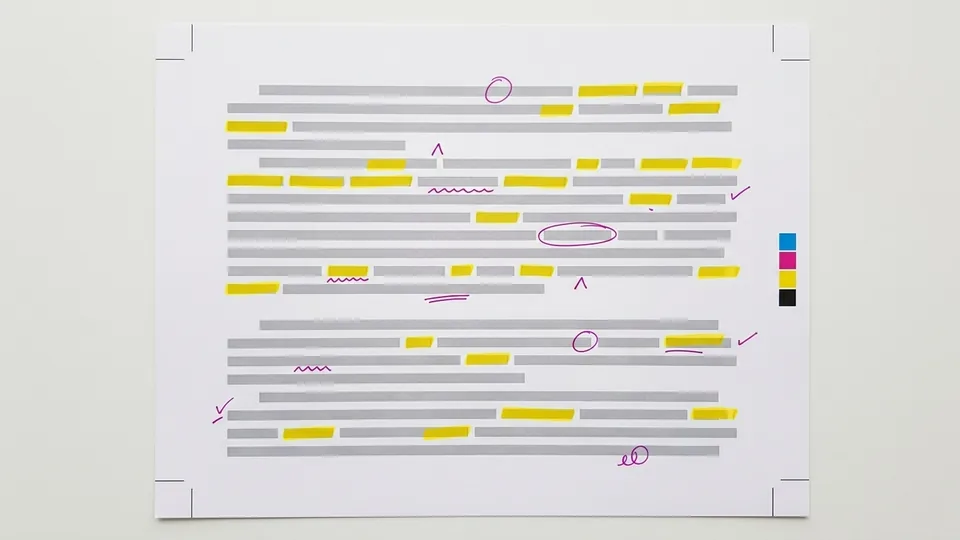
How to mark buzzwords in a draft
Search before you read
Use your editor's find box for the rare words in the table: delves, realm, tapestry, testament, commendable, meticulous. Highlight each hit.
Read the highlighted paragraphs in full
A buzzword next to a real fact is a style problem. A buzzword with nothing around it is a content problem. Note which one you have.
Mark phrases in a second color
Add the stock phrases from the list above, so word-level and phrase-level marks stay apart.
Write the margin note
Next to each cluster, write the plain version or the missing fact: which study?, shows what?, how much?. The note is what the writer will use.
Rewrite the sentence, not the word
Replacing delves with explores leaves the sentence as empty as before. Rewrite from the fact, using the method for rewriting marked passages in your own voice.
A worked example: before and after
This sample sentence was written for this page. It is an example, not a quotation from a real paper.
Seven marks in one sentence: delves, intricate, realm, showcasing, pivotal, underscoring, meticulous. The sentence names a topic and makes no claim. The margin note asks: What did the study find, in which soil, measured how? A rewrite from the study's own results might read, again as an example: We measured fungal network density in 40 wheat plots and found that plots with denser networks lost less nitrogen after heavy rain. No word in the rewrite is on any list, and the reader now knows something.
Pitfalls when marking AI buzzwords
- Reading a list as proof. All three studies describe whole bodies of text. A word that rose across millions of abstracts can still appear in any honest sentence.
- Forgetting the field. The studies counted scientific writing and peer review. Potential and findings are normal in a lab report, and landscape is normal in geography.
- Swapping synonyms. A thesaurus pass removes the listed word and keeps the empty sentence.
Tips for using a buzzword list well
- Count density, not presence. Three rare words in one sentence say more than one in a page.
- Pair each mark with a question. Shows what? is more useful to a writer than a yellow word.
- Keep the list short and current. Use the rare words from the studies; skip common ones unless they stack.
- Use the guides as a sequence. The AI writing guides run from marking a draft to rewriting and proofing it.
AI buzzwords are real, measured and easy to find, which makes them a good place to start and a poor place to stop. Search for the rare words, read the paragraphs around them, and write the question each one raises. Rewrite from the answer. Mark the buzzwords, then fix the sentence.
Common questions
What are the most common AI buzzwords?
The words with the strongest evidence are delves, underscore and showcase, which rose to 28, 13.8 and 10.7 times their expected rates in 2024 PubMed abstracts, plus realm, intricate and pivotal, the top four model-preferred words in a study of arXiv and bioRxiv papers. In peer reviews, commendable, meticulous and intricate rose sharply in ICLR 2024.
Why does ChatGPT use the word delves so much?
The counting studies measured how much more often the word appears, not why. Kobak and colleagues found delves at 28 times its expected rate in 2024 biomedical abstracts. A frequency count cannot settle the cause, so treat any single explanation as unproven. For marking a draft, the useful point is the frequency, not the reason behind it.
Does using these words mean my writing looks AI-generated?
Not by themselves. Every word on the lists was used by people before chatbots, and the studies describe shifts across millions of texts rather than single documents. A reader who sees several rare buzzwords in a sentence that makes no specific claim may grow suspicious, so the practical fix is specific content, not avoiding a word you normally use.
Which AI buzzwords should I replace first?
Start with the rare, showy words: delves, realm, tapestry, testament, commendable and meticulous. They carry little meaning in most sentences and stand out to readers. Leave common words such as potential, findings or within unless they stack up, because they usually do real work in the sentence and replacing them adds nothing.
Will replacing AI buzzwords fool an AI detector?
Replacing words is not a reliable way to change how a text reads or scores, because the sentence structure and the lack of specific content stay the same. Research on grammar shows models also differ from people in clause types and noun-heavy phrasing. The better goal is a clear sentence with real information, written in your own words.
Sources
- Kobak, Gonzalez-Marquez, Horvat and Lause: Delving into LLM-assisted writing in biomedical publications through excess vocabulary (arXiv 2406.07016, published in Science Advances)
- Liang et al.: Mapping the Increasing Use of LLMs in Scientific Papers (arXiv 2404.01268)
- Liang et al.: Monitoring AI-Modified Content at Scale: A Case Study on the Impact of ChatGPT on AI Conference Peer Reviews (arXiv 2403.07183)
- Wikipedia: Signs of AI writing, words to watch (WikiProject AI Cleanup field guide)
sign-off
Checked against its sources and signed before it went out.
Nora Feld
Editor · reviewed 1 Nov 2026