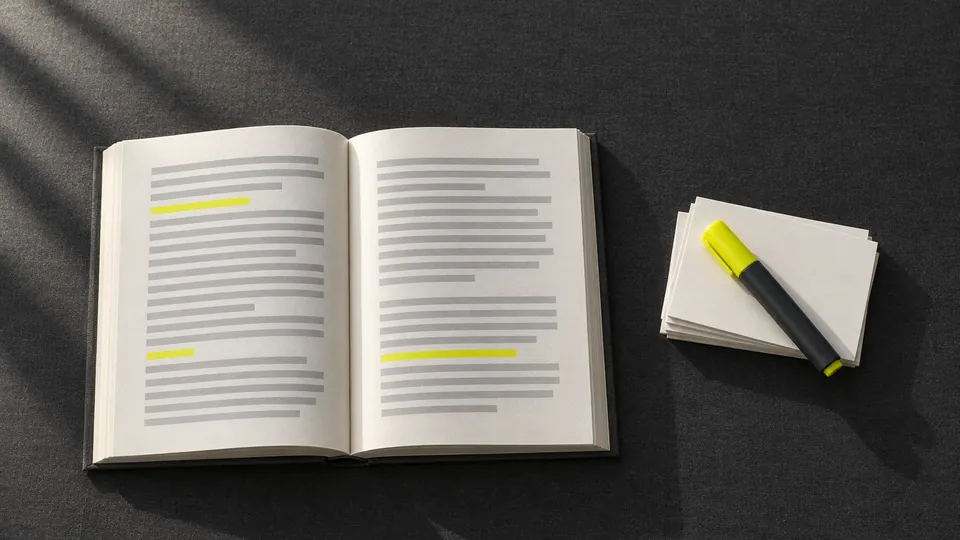
Writers have always produced drafts, notes and crossed-out paragraphs; what has changed is that those leftovers now matter. When a teacher is unsure how a piece of work was produced, the fairest thing anyone can look at is the process, and a student who kept it can answer the question in minutes. This page shows how to keep a process record without extra work, and how to mark it so the important changes are obvious to someone reading it for the first time.
What to keep while you write
| Keep | Why it matters | Effort |
|---|---|---|
| Version history in your editor | Shows the work growing over days, with dates, in small steps | None: turn it on and leave it |
| The sources you read, with your highlights | Shows you read what you cite and what you took from it | Low: highlight as you read anyway |
| Your outline or plan | Shows the structure came from you before the prose did | Low |
| One saved draft per writing session | Lets a reader compare two moments of the work side by side | Low: save a copy with the date in the file name |
| A short process note | Tells the reader what changed and why, in your words | Ten minutes at the end |
Online editors keep a history of changes automatically; desktop word processors can keep previous versions when files are saved to a cloud folder. Check your editor's help pages once so you know where the history lives. On paper, date each draft at the top and keep them in a folder.
Marking your drafts in three passes
Highlight what changed between two drafts
Put your first full draft next to the final one. In yellow, mark every passage in the final version that is new or was substantially rewritten. Real revision is uneven: some paragraphs stay almost identical, a few are rebuilt, and an argument or example often arrives late. That unevenness is exactly what a reader expects to see.
Link each source claim to its source
In a second colour, mark each sentence that depends on something you read. In your saved copy of the source, highlight the passage it depends on. For web sources, a highlight link from the link generator takes your teacher straight to the sentence you used.
Write a process note of five sentences
What was your first idea, and what changed it? Which source mattered most? What did you cut, and why? Which part was hardest? Did any tool help, and with what? The last question is the one teachers most want answered; writing an honest disclosure of tool help shows how to phrase it.
What a teacher sees when they read it
A teacher reading a marked record looks for the same things they look for in a conversation about the work: an idea developing over time, sources that were really read, and choices the writer can explain. Our page on a fair authorship review using highlights describes that review from the teacher's side. Students who hand in a record like this rarely need the conversation at all, and when they do, it is short, because the evidence is already on the table.
The record also protects against the weakest kind of evidence. Automated writing checks can flag human work, especially from writers using English as an additional language, and a style that happens to be plain or formulaic can look suspicious to a hurried reader. A dated trail of drafts is much harder to argue with than any score or impression.
Habits that make the record better
- Write in one place. Drafting in several apps and pasting the result together erases the history. If you must move text, keep the older file.
- Make your notes in your own words. Notes built from highlights, as in turning highlights into notes you use, show your understanding directly.
- Do not clean up the history. Deleted false starts and awkward first sentences are part of the evidence. Leave them.
- Share, do not attach, when you can. A view-only share of the document with its history is more convincing than a folder of exported files.
None of this needs special software, and all of it helps the writing as well as the record: a marked comparison of two drafts is also the fastest way to see whether your revision actually improved the argument. The rest of the pages on highlighting for study cover the reading side of the same skills.
Common questions
How can I prove I wrote my essay myself?
Keep version history on, save dated drafts, keep the sources you read with your highlights, and write a short note on what changed and why. A marked comparison of your first and final drafts shows the work growing.
Does version history show when text was pasted in?
Most editors record each change with a time, so a large block appearing at once is visible, as is a steady build-up of small edits. That is why writing in one document helps.
What should a process note include?
Your first idea and what changed it, the source that mattered most, what you cut, the hardest part, and any tool that helped and how. Five honest sentences are enough.
Should I keep drafts on paper too?
Yes, if you draft on paper. Date each page and keep them together; a photo of each draft is a good backup.
Is a process record useful if nobody asks for it?
It is still the quickest way to review your own revision, and it costs almost nothing to keep. When a question does come up, it answers it immediately.