Record
How to Cite a Quote So a Reader Can Check It
A citation is a promise that the words are real and that a reader can find them. Highlight the line in the source first, then write the citation from the highlight.
Every style guide explains how to cite a quote, and the mechanics differ only in punctuation and order. What the guides assume, and students often skip, is the step before the citation: having the exact words in front of you, marked in the source, with the page or paragraph noted. This page treats that as step one. Then it shows one sentence from Darwin formatted in APA 7, MLA 9 and Chicago, and covers the questions that follow: block quotes, how to introduce a quotation, ellipses and brackets, and what to do when a web page has no page numbers.
In short
To cite a quote, copy the exact words inside quotation marks, then add an in-text citation with the author, the year if your style uses it, and the page or paragraph number: (Darwin, 1859, p. 490) in APA, (Darwin 490) in MLA, a numbered note in Chicago. Give the full source in your reference list.
Start with the highlighted source, not the citation
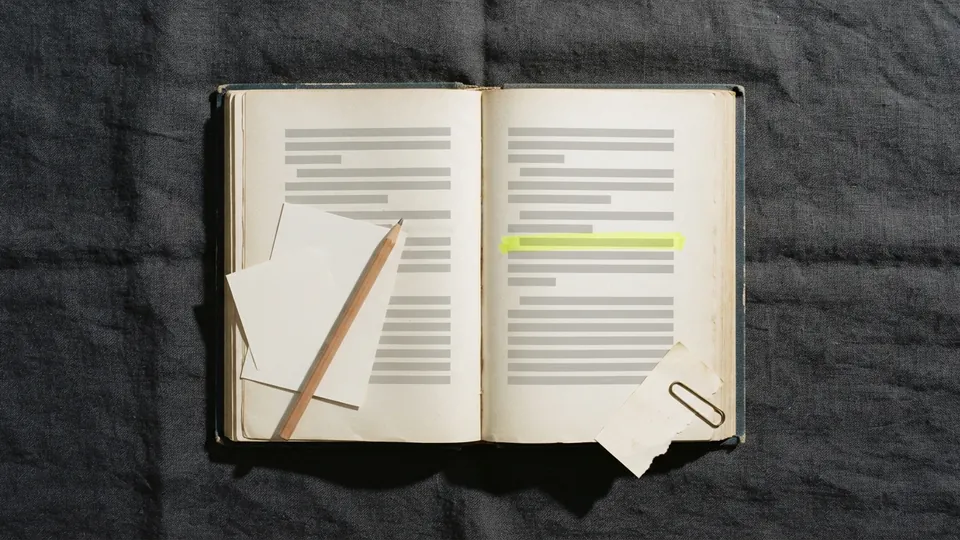
Before you write anything, open the source and mark the sentence you intend to quote. In a book, that is a pencil line and a page number in the margin. In a PDF, it is a highlight with a comment. On a web page, it is a highlight link: an address that opens the page at that sentence. The reason is simple: quotations drift. Words get dropped when retyped, a paraphrase gets remembered as a quote, and a line copied from a secondary source may already be wrong. Marking the original first means the citation describes something you have seen.
It also means you have a record. When an editor or teacher asks where a line came from, you open the marked source and point. Our guide to confirming a quotation in the original before you use it covers what to do when you found the words second-hand.
How to cite a quote in APA, MLA and Chicago
The three main academic styles agree on what a quotation needs: the exact words, the author, the location of the words in the source, and a full entry in the list at the end. They differ in how the pieces are arranged. The table shows the same short quotation from the first edition of Charles Darwin's On the Origin of Species (John Murray, 1859), page 490, in all three.
| Style | In the text | In the list at the end |
|---|---|---|
| APA 7 | Darwin closes with the image of "endless forms most beautiful and most wonderful" (Darwin, 1859, p. 490). | Darwin, C. (1859). On the origin of species by means of natural selection. John Murray. |
| MLA 9 | Darwin closes with the image of "endless forms most beautiful and most wonderful" (Darwin 490). | Darwin, Charles. On the Origin of Species by Means of Natural Selection. John Murray, 1859. |
| Chicago, notes and bibliography | Darwin closes with the image of "endless forms most beautiful and most wonderful."1 Note: 1. Charles Darwin, On the Origin of Species by Means of Natural Selection (John Murray, 1859), 490. | Darwin, Charles. On the Origin of Species by Means of Natural Selection. John Murray, 1859. |
Two details are easy to miss. APA uses sentence case for the book title (only the first word and proper nouns capitalised) while MLA and Chicago use title case. And the Chicago citation quick guide notes that, since the 18th edition, a place of publication is no longer required for books, which is why London does not appear. If your teacher uses an older edition, add it.
If the author's name is in your sentence, APA keeps the year and page in the parentheses, (1859, p. 490), and MLA keeps only the page, (490). Chicago is unaffected, because the note carries everything.
Short quotes and block quotes
Each style has a length above which a quotation is set off as an indented block without quotation marks. APA sets the line at 40 words. MLA uses more than four lines of prose as typed in your paper. Chicago leaves it to judgement but suggests block format for around a hundred words or more, or anything longer than a paragraph.
Darwin's full closing sentence is 57 words: "There is grandeur in this view of life, with its several powers, having been originally breathed into a few forms or into one; and that, whilst this planet has gone cycling on according to the fixed law of gravity, from so simple a beginning endless forms most beautiful and most wonderful have been, and are being, evolved." In APA that must be a block quote, with the citation after the final full stop. In MLA it runs to about four lines on a standard page, right at the border, and most teachers would accept either form. Chicago would run it in the text.
In a block quote the citation goes after the closing punctuation, not before it. In a short quote it goes before the full stop: your sentence ends after the parentheses.
Introducing and punctuating a quote
Say who is speaking and why the words matter
Introduce the quotation with the author's name and a verb that fits what they are doing: argues, observes, concedes, warns. Darwin closes the book with an image tells the reader what to notice. A quotation dropped in without an introduction is one the reader has to interpret alone.
Choose the joining punctuation
A full sentence introduction takes a colon: Darwin ends on a single image: "There is grandeur in this view of life." A verb of saying takes a comma: Darwin writes, "There is grandeur in this view of life." A quotation that fits inside your own grammar takes nothing: Darwin finds "grandeur in this view of life" in what he has described.
Mark omissions with an ellipsis
If you drop words from the middle of a quotation, mark the gap with three spaced periods ( . . . ). APA and MLA both ask for this, and both say you do not need an ellipsis at the start or the end of a quotation. Never cut words in a way that changes the meaning; the highlight in your record will show the difference.
Mark your changes with brackets
Anything you add or change goes in square brackets: a clarifying name, a changed capital letter, a verb tense that fits your sentence. Write [sic] after an error in the original that you want to show is not yours. Everything outside the brackets must be the author's words exactly.
Place the citation and end the sentence
For a short quote, close the quotation marks, add the parenthetical citation, then the full stop. For a block quote, end the quotation with its own punctuation and put the citation after it. In Chicago, put the note number after the closing punctuation.
Web pages: paragraph numbers and highlight links
Web pages rarely have page numbers, and the styles handle this differently. APA asks you to give a paragraph number, counted from the top, as (Author, 2024, para. 4), or a heading name plus a paragraph count under it. MLA says to include a page or paragraph number only if the source itself displays one; otherwise the author alone is the citation. Chicago allows a descriptive locator, such as a section heading, in the note.
Whatever the style asks for, you can add something better in your own record: a link that opens the page at the quoted words. Browsers that support text fragments, which now includes current versions of Chrome, Edge, Safari and Firefox, read an address ending in #:~:text= followed by the quoted words and scroll straight to them with the text marked. For the Darwin sentence in the Project Gutenberg copy of the first edition, that link is:
Highlight link
https://www.gutenberg.org/cache/epub/1228/pg1228-images.html#:~:text=There%20is%20grandeur%20in%20this%20view%20of%20life
You can build one by pasting the sentence into our highlight link page, and how a text fragment link is put together and when it fails explains the syntax and the limits. Put the link in the reference entry if your style allows a URL there, and in any case keep it in your notes beside the quote.
Keeping the marked source as your record
The citation goes to the reader. The marked source stays with you. For a book, that is the page with the pencil line, or a photograph of it. For a PDF, it is the file with the highlight and its comment. For a web page, it is the highlight link and, because pages change, a saved copy of the page with the date. Keep them in the folder with the essay.
This is what makes a quotation defensible rather than merely well formatted. If the words are challenged, you show the highlight. If the page has since changed, you show the dated copy. The same habit applies with more force to text from a chatbot, which has no stable address at all; quoting a chatbot answer and keeping a record of it deals with that case. Both belong to the annotation-as-record guides, where the principle is the same: marks that show what you read and what you quoted.
Pitfalls when citing a quote
- Quoting from memory or from a secondary source. Famous lines circulate in altered forms. Find the original and mark it.
- Citing the book when you read the web version. Cite the version you actually used, and give its address, so the page numbers match.
- Silent edits. A changed word without brackets is a misquotation, even when the change is small.
- Losing the page number. Every style wants a location for a direct quotation where one exists. Write it beside the highlight when you make it, not later.
- Quoting too much. Quote the words that carry the point and paraphrase the rest, with a citation for the paraphrase too.
Citing is the last step of a chain that starts with marking. Annotating so the marks become a record covers the asterisk-and-locator habit that makes the quotation easy to find again, the verification log for checked claims is where a journalist keeps the same information, and the section on highlights as a record lists every related page.
Common questions
How do I cite a quote from a book in APA?
Put the author's surname, the year and the page number in parentheses after the quotation: (Darwin, 1859, p. 490). For a range of pages use pp. Then list the book in your references: author, year, title in italics and sentence case, publisher.
How do I cite after a quote?
Close the quotation marks, add the parenthetical citation, then end the sentence with a full stop. For a block quotation the order flips: the quotation ends with its own punctuation and the citation follows in parentheses with no full stop after it.
How do I introduce a quote in an essay?
Name the author and use a verb that describes what the quotation does: Darwin argues, observes, concedes. Follow a full sentence with a colon, a verb of saying with a comma, and use no punctuation when the quotation fits inside your own sentence.
How do I cite a quote from a web page with no page numbers?
In APA, count paragraphs and write para. and the number, or give a heading and a paragraph count. In MLA, cite the author alone unless the page displays numbers. In your own notes, keep a highlight link that opens the page at the quoted words.
Do I need quotation marks for a block quote?
No. A block quotation is indented as a whole and carries no quotation marks; the indentation does that job. Any quotation marks inside the original are kept as they appear. The citation follows the final punctuation of the block.
Knowing how to cite a quote comes down to four moves: mark the exact words in the source, copy them without changes, write the in-text citation with a location, and give the full reference at the end. Do the marking first and the rest follows from it, and you keep a record that outlasts the essay. If you use web sources, make the highlight link before you write the sentence.