Record
Primary Sources and Provenance: Trace a Claim to Its Origin
A claim reaches you at the end of a chain of copies. Provenance is that chain, and walking it back to the primary source is the only way to know the words are real.
A primary source is the thing itself: the letter, the dataset, the recording, the law as passed. Most of what you read is not that. It is a summary of a summary, and each copy can drift a little from the one before it. Provenance is the chain that connects the claim in front of you back to the original, and this page is about walking that chain. Below: the three kinds of source with examples from three fields, the steps for tracing a claim, when a copy is not the original, and one famous line walked back to the document it came from.
In short
A primary source is an original record created at the time of an event or by the person who did the work: a diary, a dataset, a court transcript, a photograph. Secondary sources interpret primary sources; tertiary sources summarise both. Provenance is the chain of copies between a claim and its primary source.
What a primary source is, and what it is not
The Library of Congress describes primary sources as the raw materials of history: original documents and objects created at the time under study. Yale's primary sources guide adds that they provide firsthand testimony or direct evidence, usually from witnesses or recorders who were there. A memoir written decades later still counts, because the author was a witness. A textbook about the same event does not.
A secondary source is one step away. It reads primary sources and interprets them: a history book, a review article, a news analysis. A tertiary source is a step further still. It condenses secondary sources, often without naming them: an encyclopedia entry, a textbook chapter, a chatbot's answer. Tertiary sources are useful for orientation and useless as evidence.
The University of Illinois library tutorial adds that nothing in a source makes it primary or secondary by itself; the category depends on your question. A 1935 book about Reconstruction is secondary for the 1870s and primary for what scholars believed in 1935. Ask what your claim is about, then ask which document is closest to it.
Primary, secondary and tertiary in three fields
| Field | Primary source | Secondary source | Tertiary source |
|---|---|---|---|
| History | A letter, a diary, a treaty, a photograph, a court record from the time | A historian's book or article that interprets those records | An encyclopedia entry or a school textbook that summarises the historians |
| Science | The dataset, the lab notebook, the paper that first reports the experiment | A review article or a meta-analysis that weighs many papers | A news piece or a fact sheet that states the finding without the method |
| Journalism | The document the reporter obtained, the interview recording, the official bulletin | The reporter's article built from those materials | A roundup, an aggregator post, a summary passed along on social media |
How to trace a claim back to its primary source
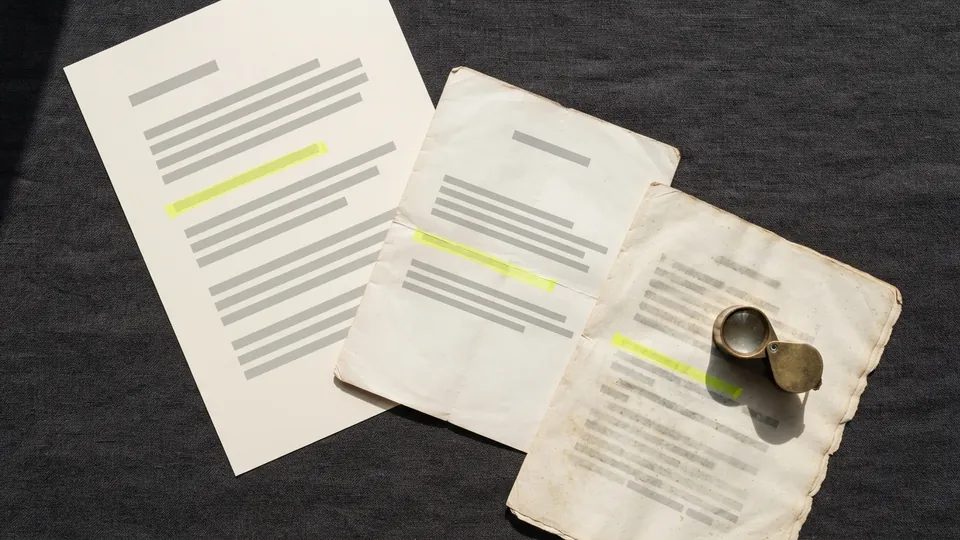
Walking a claim back is a short routine, the same in every field. On paper, replace the highlight link with a page number and a photograph.
Highlight the claim exactly as you found it
Mark the sentence where you met it. Note the source, the date and, for a web page, a highlight link to the sentence. This is the top of the chain.
Follow the citation
A footnote, a linked phrase or a named report is the next link. Open it. If there is no citation, search the distinctive words in quotation marks; the earliest dated copy is your lead.
Keep going until you reach the original
Each source you open may be quoting someone else. Repeat. You have arrived when the document in front of you is the thing the claim is about: the law, the dataset, the paper, the recording.
Highlight the exact line in the original
Find the words or the figure and mark them. Compare with step one and note every difference, however small; the differences are where errors live.
Record the landing point
For a web page, make a highlight link to the line and keep it with the date. For a PDF or a book, the page and paragraph. For a dataset, the table and the row. A stranger should find the words in under a minute.
Write the chain down
List the links: where you found the claim, what it cited, what that cited, where it ended. That list is the provenance of the claim, and it belongs beside the claim in your draft.
A highlight link is a web address with the sentence appended after #:~:text=; current browsers open it scrolled to the words. Paste the sentence into the page that builds a link to a highlighted sentence, which stores nothing. The syntax and its limits are in the guide to linking a reader to marked text.
When a copy is not the original
Four kinds of copy deserve suspicion before you treat them as the end of the chain.
- Transcriptions. A typed version of a handwritten document is a human reading of it. Good ones say what they were made from; check the line against the image where one exists.
- Translations. A translation is an interpretation by definition. If the claim rests on a word, find the passage in the original language and record both.
- Quotations in secondary books. A historian quoting a letter is not the letter. The footnote says where it is; go there.
- Screenshots. A screenshot proves that pixels existed on a screen, not that the page said that, or when. Find the live page or a dated archived copy and highlight the line there.
When the original is out of reach, record the best copy you reached and say so: closest available: the archive's transcription. A note that silently stops at a textbook is not a record.
A worked example: one line from the Declaration of Independence
Suppose a study guide tells you that the Declaration of Independence promises "certain inalienable rights," and you want to quote the phrase. Here is the chain, walked back.
- Link 1: the study guide. Highlight the sentence. It gives no citation. A search finds thousands of copies, split between inalienable and unalienable.
- Link 2: the National Archives transcript. The United States National Archives publishes a transcription. The line reads: "that they are endowed by their Creator with certain unalienable Rights." Highlight it. The study guide's word was wrong.
- Link 3: what the transcript copies. The Archives says at the top of the page that its text is a transcription of the Stone Engraving of the parchment, with spelling and punctuation as in the original. Even the official transcript is a copy of a copy, and it says so.
- Link 4: the parchment. The Archives records that Congress ordered the Declaration engrossed on parchment on July 19, 1776, that Timothy Matlack most likely did the lettering, and that signing began on August 2. The parchment is the primary source; a high-resolution image of it is on the same site.
Provenance note
Claim: "certain inalienable rights" (study guide, read 24 Sept 2026). Original: parchment Declaration, engrossed July 1776. Closest checked copy: National Archives transcript of the Stone Engraving. Exact wording: "certain unalienable Rights." Link: https://www.archives.gov/founding-docs/declaration-transcript#:~:text=certain%20unalienable%20Rights
Four links, one changed word. For quotations whose first appearance is itself in doubt, following a quotation back through its reprints to the first edition covers the harder cases.
Why the chain is part of your record
The note above lets a reader check the claim in seconds, and it shows that you did the checking on a given date. Dated highlight links to primary sources are evidence of reading in a way a reference list is not: references say what you consulted, links say what you saw and when. If you verify many claims in one piece, a claim-by-claim log with one line per source keeps the chains from tangling, and the other guides to using highlights as a record cover what to do with the log afterwards.
Pitfalls when tracing a primary source
- Stopping at the first respectable page. A university or museum page is often secondary. The top of the page usually says what the text was made from.
- Trusting the citation without opening it. Citations get copied along with the claims, errors included. A footnote tells you where to look; opening it is the confirmation.
- Treating a search result as an original. The earliest dated copy you can find is a lead. Ask where it got the words before you call it the source.
- Recording only the final link. A note that says only National Archives hides that the study guide was wrong. Write the whole chain.
- Letting the copy drift again. Paste the line from the highlight rather than retyping it. Most misquotations are born in the last step.
Expert tips from librarians and archivists
- Ask three questions of any document. The Illinois tutorial suggests: when and where was it created, who created it, and for what audience.
- Look for a statement of what a copy was made from. The National Archives transcript names the engraving it follows. One that says nothing about its source is a weaker link.
- Prefer the copy with an image. Use the transcription for the link and the scan for the word.
- Date every highlight. Web pages change. A link plus a date plus a saved copy is a record; a bare link is a hope.
- Write the chain before you write the sentence. Notes made after the draft are reconstructions from memory.
The provenance habit runs through three other record pages: the routine for a quotation that may be misattributed or invented, website citations that point at the exact page and an archived copy, and keeping a believable record of what a page said and when.
Common questions
What is a primary source, in simple terms?
A primary source is an original record made at the time of an event or by the person who did the work: a letter, a photograph, a dataset, a transcript, a law as passed. The Library of Congress calls them the raw materials of history, as opposed to accounts that retell or interpret events later.
What is the difference between primary, secondary and tertiary sources?
A primary source is the original evidence. A secondary source interprets primary sources: a history book, a review article. A tertiary source summarises secondary sources, often without naming them: an encyclopedia, a chatbot answer. Cite the first, read the second, use the third only to find your way.
Can a newspaper article be a primary source?
Yes, when your question is about what was reported or believed at the time. The Illinois library tutorial gives a 1959 article on a Nixon visit as an example. If your question is about the event itself, the article is a step removed from the documents and interviews it drew on, and you should follow those.
Is a transcript a primary source?
A transcript is a copy of a primary source made by a person, so it can contain errors and editorial choices. Good transcripts say what they were made from. Treat one as your closest checked copy, record that fact, and compare the line against an image of the original when one exists.
How do I cite a primary source I found through a secondary one?
Cite what you actually read. If you reached the original, cite it and keep the chain in your notes. If you could not reach it, cite the secondary source with the words quoted in, and say so plainly. The rules for each style are in the citation guide for quotations in three styles.
A primary source is the end of a chain, and provenance is the chain itself. Highlight the claim where you found it, follow each citation back, highlight the exact line in the original, and write down every link with a date. The habit costs a few minutes per claim, catches errors like the changed word above, and leaves a record of what you read and when. The next time a claim matters, walk it back to the primary source before you repeat it.
Sources
- Library of Congress: Getting Started with Primary Sources
- Primary Sources at Yale (Yale University Library): What are primary sources?
- University of Illinois Library, History, Philosophy, and Newspaper Library: Types of Sources and Where to Find Them: Primary Sources
- National Archives: Declaration of Independence: A Transcription