Record
How to Annotate a Text So Your Marks Become a Record
Annotation is reading with a pen in your hand. Done with a little care, the marks you leave show what you read, what you doubted and which line you quoted, months later.
Most advice on how to annotate a text stops at comprehension: mark the main idea, circle new words, write a question. That is where this page starts, but an annotated text can do a second job. If each mark says what kind of thing it points at, and each note says why you made it and when, the marked pages become a record: proof of what you read, what you took from it and where a quotation came from. That record matters when a teacher asks about your sources, and when you return to the text a year later.
In short
To annotate a text, read a section once, then go back and mark four things: the claims, the evidence given for them, your questions, and terms to look up. Use a small fixed set of symbols, write a margin note that says why each mark matters, and date and source every note so the pages work as a record.
What annotating a text is for
Annotation is the set of marks and short notes you add to a text while reading: underlines, highlights, symbols in the margin, a word circled, a question written beside a paragraph. The Learning Center at the University of North Carolina describes it as a systematic summary you build inside the document and a tool for close reading that helps you notice patterns and main points. Both descriptions are about understanding.
The record use is different. When you later quote a line, a teacher or editor may reasonably ask where it came from and whether you read the passage around it. Marked pages answer that in seconds, but only if the marks are legible to someone other than you: a fixed symbol set and notes that explain themselves. That discipline costs very little extra time.
What to mark: claims, evidence, questions, terms
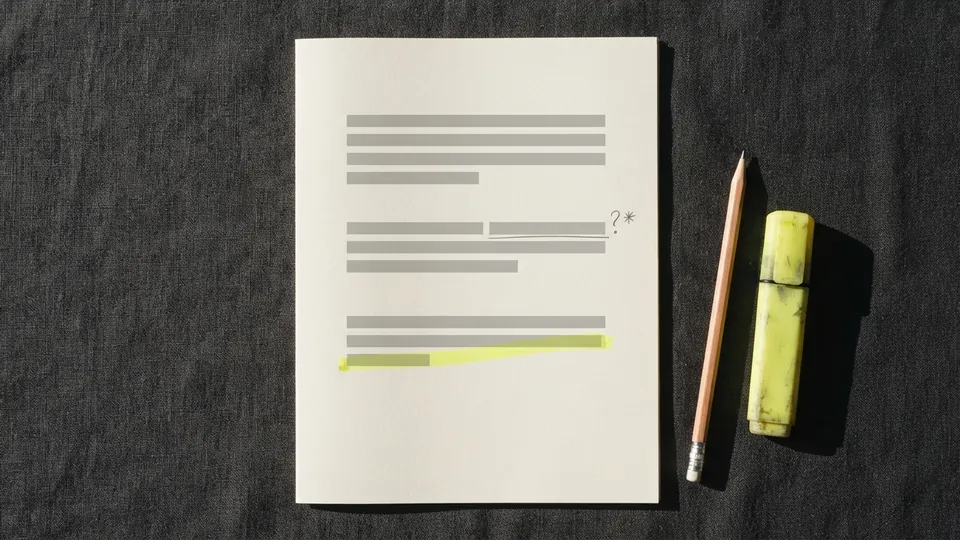
A text is easier to annotate when you have a short list of things you are hunting for. Four categories cover most non-fiction, and they map onto the questions you will ask later when you write. Choose one mark per category and do not add more for a month.
| Mark | Meaning | What you write in the margin |
|---|---|---|
| Underline | A claim: something the author asserts | One or two words naming the claim, so you can find it again |
| Highlight | Evidence: a fact, example, figure or quotation offered in support | Which claim it supports, and whether you checked it |
| ? in the margin | A question or a doubt about the passage | The question itself, in a few words |
| Circle | A term to look up or define | The definition, once you have it, and where it came from |
| * (asterisk) | A passage you may quote or cite later | The page or paragraph number and the date you marked it |
| Arrow | A link between two passages, or to another source | What the connection is |
The first four are the core set; the asterisk and the arrow exist for the record. When you use a highlighter for evidence only, the yellow band becomes a specific signal rather than a general feeling that something seemed important, which is the habit that makes highlighted textbooks useless. If you want colour to carry more meaning, pair this table with a colour code limited to three colours; with more than three you will forget what they mean.
How to annotate a text, step by step
Read the section once without a pen
Read to the end of the section first, then go back. Marking on the first pass produces too many marks, because everything looks important before you know where the argument goes. The UNC handout gives the same advice: separate the reading pass from the annotating pass.
Underline the claims
On the second pass, underline each sentence where the author asserts something. Write one or two words in the margin naming it. If a paragraph has no claim, leave it alone; not every paragraph earns a mark.
Highlight the evidence and tie it to a claim
Highlight the facts, examples and quotations the author offers in support. Beside each, write which claim it belongs to. If you can check it (a date, a name, a figure), write checked or not checked. That single word is what turns a highlight into a claim you can stand behind later, and it is the whole method of marking a source's claims and testing each one.
Write questions and circle terms
Put a question mark beside anything you doubt or do not follow, and write the question. Circle terms you need to define and come back with the definition and where you found it. A question you wrote down is a question you will answer; one you only thought is gone by the next page.
Add a star and a locator to anything you may quote
Beside any sentence you might quote, put an asterisk and write the page number, or the paragraph number for a web page. Write the date. This is the note you will be gladdest to have when you write the essay.
Head the first page with the source
At the top of the first page, or in the file name for a PDF, write the full source: author, title, edition, date, and the address for a web page. A loose photocopy, or a PDF called download (3), is not a record of anything.
A worked example on one paragraph
Here is a short paragraph on how honey bees keep their nest warm, written for this page. Below it is how a careful annotation of it would look, mark by mark.
The paragraph
A honey bee colony keeps the part of the nest that holds developing young within a narrow range of temperature. When that area cools, worker bees press against the comb and shiver their flight muscles without moving their wings, which produces heat. When it grows too warm, other workers fan air across the comb, and some bring in water and spread it in thin films so that evaporation carries heat away. No single bee measures the whole nest. Each responds to the conditions at its own spot, and the sum of those small responses holds the nest steady.
- Underline the first sentence: the claim is that the colony regulates the temperature of its young. Margin: regulation claim.
- Highlight the shivering sentence and the fanning-and-water sentence: these are the evidence, two mechanisms. Margin: supports regulation claim; not checked.
- Circle flight muscles: a term worth defining. Margin: the muscles in the thorax that drive the wings (checked in a general biology reference).
- ? beside narrow range: the paragraph gives no figures. Margin: how narrow? find a source with numbers.
- * beside the last two sentences, which you might quote as an example of a system with no central controller. Margin: para. 1, marked 24 Sept 2026.
Notice what the annotated paragraph now says to a stranger. They can see which sentence you treated as the claim, which as support, what you doubted, and which lines you might quote, with a date. If you later write that bees cool the nest by evaporation, the star and the highlight show where that came from, and the question mark shows you knew the paragraph gave no figures.
Paper, PDF and web page: the same marks in three places
On paper
Use a pencil for underlines and margin notes and a highlighter for evidence only. Write the source at the top of the first page and number the pages if the copy has none. Photograph the marked pages when you finish; a photo carries a date, and paper gets lost.
In a PDF
Adobe Acrobat, Preview on a Mac, and the built-in PDF viewers in Chrome, Edge and Firefox all offer highlight and comment tools. Put the margin note in the comment attached to the highlight rather than in a separate sticky note, so the reason travels with the mark. Save the annotated file under a name that includes the author and the date. In Acrobat the comments can be exported as a list, which is a ready-made reading record.
On a web page
Browser highlighter extensions store your marks, but a marked passage on the web has a better anchor: a link that opens the page at the exact sentence. Paste the sentence into the highlight link builder and it produces an address with the words embedded after #:~:text=. Current versions of Chrome, Edge, Safari and Firefox open such a link scrolled to the passage, according to the MDN reference on text fragments. Keep the link beside the star, and your record points at the exact line.
Pitfalls that ruin an annotation
- Marking on the first read. You end up with half the page underlined and no way to tell claim from support.
- Symbols that mean nothing. A star that sometimes means quote and sometimes means interesting is not a record. Keep the table and stick to it.
- Notes without a why. An exclamation mark beside a paragraph tells your future self nothing. Contradicts chapter 2 does.
- No source, no date. A perfectly annotated page you cannot place is a curiosity. Head every document with its source and date your quotable marks.
- Fixing the record later. If you change your mind, add a new dated note. Do not erase the old one; the change of mind is part of the record.
Expert tips for annotating for evidence
- Annotate the argument, not the sentences. Harvard Library's guide to reading habits suggests outlining a text's skeleton in the margin: thesis, first point, second point. Doing this beside your claim marks shows how the claims connect.
- Write the margin note as a sentence you could read aloud. If it would embarrass you to read it to the author, it is a reaction rather than a note.
- Keep a legend on the inside cover or the first page. One line per symbol. A teacher reading your copy should not need you in the room.
- Turn the marks into notes within a day. The marks are raw material; writing notes from the passages you marked is where understanding happens, and the notes cite the marks.
- Treat the annotated copy as a file you keep. For coursework, keep it with the essay it fed. The pair, essay plus marked sources, is the clearest record of authorship there is, and the reason highlights as a record has its own section on this site.
The marks described here feed the rest of the record section: the starred lines become the quotations in citing a quote with a link to the line, the claim and evidence marks are the raw material of an annotated bibliography drafted from your marks, and getting the marks out of the app as a dated file is what makes them a record you still own next year.
Common questions
How do you annotate a text quickly?
Read the section first, then mark on a second pass using only the six symbols in the table. Marking while you read is what makes annotation slow, because you stop at everything. A second pass over a section you already understand takes a few minutes.
What are the standard annotation symbols?
There is no universal standard, only conventions. Common ones are an underline for a claim, a highlight for evidence, a question mark for a doubt, a circle for a term, an asterisk for something to quote, and an arrow for a connection. Pick one set and write a legend.
What is annotating for evidence?
It means marking the parts of a text you could later use to support a point: facts, examples, quotations and figures, each tied to the claim it supports and labelled as checked or not checked. The marks then act as a record of where your evidence came from.
Should I highlight or underline when annotating?
Use both, for different things. Underline claims in pencil so you can see the author's argument; highlight evidence so the colour means one thing. Highlighting everything that seems important is the habit that makes highlighted pages hard to use later.
How do I annotate a text on a computer?
In a PDF, use the highlight and comment tools in Adobe Acrobat, Preview or your browser's PDF viewer, and put the reason in the comment attached to the highlight. On a web page, make a highlight link to the passage and keep it with your note.
Knowing how to annotate a text is mostly knowing what to look for: claims, evidence, questions and terms, marked with a small set of symbols and explained in the margin. Add a source at the top and a date beside anything you may quote, and the same marks that helped you understand the text become a record you can hand to anyone. Start with the next thing you read, and write the legend first.