Record
How to Prove You Didn't Use AI: Authorship Evidence
A detector report is a guess about a finished text. A folder of dated highlights, notes, outlines and drafts is a record of how the text was made. Only one of those is evidence.
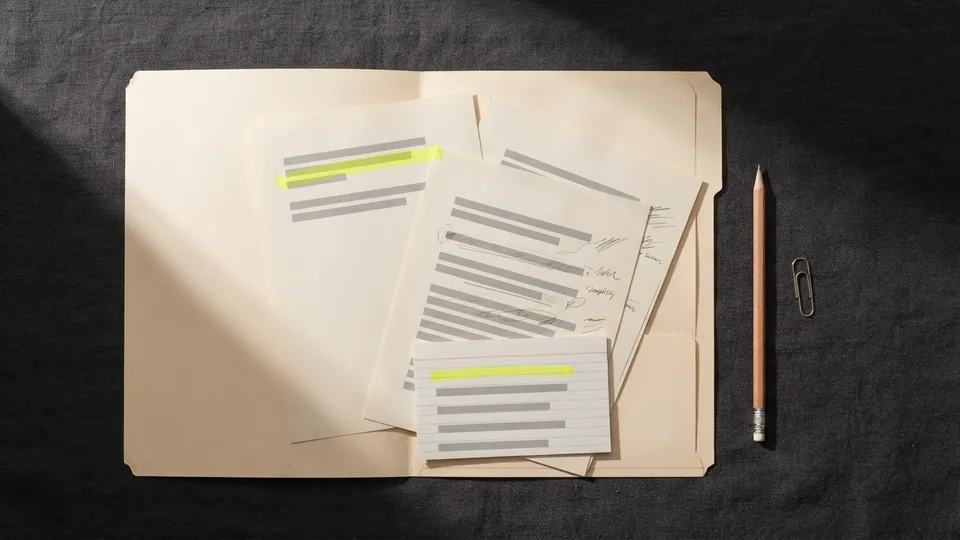
Students ask how to prove you didn't use AI after a teacher has raised the question, usually because a detector has put a number on their essay. The honest answer starts with a limit: nobody can prove a negative. What you can show is that something else did happen: you read specific sources on specific dates, marked the lines you used, planned the essay, and wrote it in drafts that changed over time. This page is about that positive record: what a detector report is and is not, which evidence carries weight, one student's folder, and what to do, calmly, if you are accused.
In short
You cannot prove that you did not use an AI writing tool. You can present a record that you wrote the work yourself: dated highlights in your sources, reading notes, an outline, the version history of your document, and drafts with your own corrections. Offer that record to the teacher and ask for a conversation.
What a detector report is, and what it is not
An AI text detector reads a passage and produces a score, often a percentage: a statistical guess about how much the text resembles the output of a text generator. It is not a record of what happened at your desk; the tool cannot see your sources, notes or drafts.
The guess is uneven across writers. A 2023 Stanford study by Weixin Liang and colleagues, published on arXiv (2304.02819), found that several widely used detectors consistently labelled non-native English writers' essays as machine-written, and cautioned against using them in educational settings. Vanderbilt University disabled the detection feature in its plagiarism software in August 2023, writing that it does not believe AI detection software is an effective tool that should be used.
Reading a detector score without over-trusting it explains how the numbers are produced.
Evidence of authorship, ranked by how convincing it is
A reader wants proof that the material existed before the deadline and proof that it came from you. The table ranks common evidence by how well it does both.
| Evidence | How convincing | How to get it |
|---|---|---|
| Version history in your writing tool | Very high: the essay grows over days, with timestamps you did not set | Write in Google Docs, Word with AutoSave, or any editor that keeps revisions |
| Dated highlights in sources, linked to each line | Very high: shows you read the passages you quote, and when | Highlight in the PDF, or make a highlight link per web quotation, and note the date |
| Reading notes in your own words | High: shows understanding formed before the essay | One dated notes file per source |
| An outline, saved as its own file | High: shows the argument was designed | Keep each version; do not overwrite |
| A statement that you did not use AI | Low on its own: it is the claim in question | Write it briefly, without anger, and attach the record |
The top rows are timestamped by something other than you: the document service, a public page, a camera. Evidence you could produce afterwards weighs less.
How to prove you didn't use AI: build the record before you need it
The record is easy to keep and nearly impossible to reconstruct, which is why it persuades.
Highlight the source, then note the date
In a PDF, highlight the line and put the date in the attached comment. On a web page, paste the sentence into the highlight link generator or use the select-and-click bookmarklet for highlight links, and save the link with the date.
Write reading notes in your own words
Write what each source argues and what you think of it, in a dated file. Working your highlights into written notes shows a routine.
Save an outline as its own file
Thesis, points, which source supports each. When the essay changes shape, save a second outline.
Draft in a tool that keeps version history
Google's help page for version history explains that you can name a version and keep up to 40 per document. Name one at the end of each session: first draft 12 Oct.
Keep one marked draft
Correct a printed middle draft by hand. Annotating each draft so the process is visible covers what to mark.
File everything in one folder per essay
Sources, notes, outlines, the marked draft and the final, named for the assignment.
A worked example: one student's evidence folder
A history student kept this folder for a 2,000 word essay on why the United States, and not France, completed the Panama Canal, due 20 October.
- Sources (six files). A journal article PDF with nine dated highlights (3 to 5 October). Two web articles as PDFs, each with a text file of five dated highlight links. Photographs of four marked library book pages, 6 October.
- Notes (three files). One per source, in the student's own words, dated 4, 6 and 8 October, each ending useful for: point 2 or similar.
- Outlines (two files). Outline v1, 9 Oct with four points and Outline v2, 13 Oct with three.
- Drafts and final (three files). The Google Docs essay with named versions on 11, 14, 17 and 19 October; a photographed printout of the 14 October version with handwritten comments; the submitted file, with a note: No AI writing tools used.
When a detector flagged two paragraphs, the student offered the folder and asked for a meeting. The teacher watched the essay grow from 300 words to 2,000 across the named versions, opened two highlight links, found the quoted sentences, and closed the matter in one conversation.
If you are accused: a calm order of operations
Ask what the concern is, in writing
Ask which passages are in question and what the evidence is. If it is a detector score, ask which tool.
Gather the folder before you argue
Collect the version history, highlighted sources, notes and outlines, or whatever exists: browser history, library loans, messages about the essay.
Write a short, factual statement
When you began, which sources you marked, how the draft developed, and every tool you used, including spelling checkers. Say once that you did not use an AI writing tool, and attach the record.
Offer to talk through the essay
Propose a meeting to walk through the argument and the sources. Vanderbilt's guidance to its own instructors suggests exactly this: check the sources and talk to the student.
Learn the procedure and keep your own record of it
Find out who decides and how to appeal; the UK Quality Assurance Agency describes the aim as fair and proportionate misconduct processes.
Teachers can run the same process from the other side; a highlight-based review of who wrote which passage gives a method for that conversation.
Pitfalls that weaken an authorship record
- Writing in a file with no history. One file with one save date shows nothing about how the essay grew.
- Pasting a draft into a fresh document. Its history begins at the paste: 2,000 words appearing at once.
- Highlights without dates or links. A yellow band proves you opened the file once. A dated comment and a link prove when and where.
- Leading with the detector's flaws. A reply that only attacks the tool leaves the question open. Lead with your record.
Expert tips from people who review authorship
- Make one highlight link per quotation, as you quote it. How a text fragment link is built and where it breaks explains what to do when a page will not take one.
- Treat the folder as the deliverable. The essay is one file in it; that is the highlights-as-a-record approach on this site.
Each piece of evidence on this page has its own guide: keeping the reading log that documents your sources, opening and naming versions so the document's own history speaks for you, and quoting with a highlighted line and a link that a marker can open.
Common questions
Can a detector prove I used AI?
No. A detector produces a probability that a passage resembles machine-written text. It cannot see how the text was made, and the 2023 Stanford study on arXiv found the scores unreliable for non-native English writers. A score is a reason to ask; a record is the answer.
What is the strongest evidence that I wrote an essay myself?
Version history showing the essay growing over days, paired with dated highlights in your sources that point at the lines you quoted. Both are timestamped by something other than you, so they are hard to fake afterwards. Notes and outlines add depth.
What if I did not keep any drafts or notes?
Gather what exists: browser history, library records, the file's creation date, messages about the essay, and your memory of the sources. Offer to discuss the essay in person and explain the argument. Then start keeping the record for the next piece of work you write.
Should I run my own essay through a detector before submitting?
It tells you what one tool guesses on one day, and the number may change tomorrow. It does not improve your evidence. A minute spent naming a version or dating a highlight is worth more, because a reviewer can check that.
How should a teacher handle a detector flag fairly?
Treat the flag as a question rather than a finding. Ask the student for their record: version history, highlighted sources, notes and drafts. Read it together and compare the essay with their other work. Vanderbilt's 2023 guidance advises against relying on detection software.
The question of how to prove you didn't use AI has no direct answer, because a negative cannot be proved. What you can do is keep a positive record of authorship: highlights dated and linked to the line, notes in your own words, an outline that changed, a document with named versions, and one draft with your corrections. Kept as you go, that folder answers a detector score in one conversation. Begin with the next source you read: highlight the line and write the date.
Sources
- Liang, Yuksekgonul, Mao, Wu and Zou (2023): AI text detectors are biased against non-native English writers (arXiv 2304.02819)
- Vanderbilt University, Brightspace and Instructional Technology: Guidance on AI Detection and Why We're Disabling Turnitin's AI Detector (16 August 2023)
- Google Docs Editors Help: Find what's changed in a file (version history)
- The Quality Assurance Agency for Higher Education (UK): Academic integrity