Spaced Repetition: How to Space Your Review Sessions Before an Exam
The same hour of review is worth more spread over days than packed into one evening. Here is what the research found, and how to turn it into a schedule.
in short
Spaced repetition means reviewing material several times with gaps between sessions instead of all at once. A 2006 meta-analysis found that the best gap grows as the time until the test grows, and a 2008 study put the best first gap at about 20 to 40% of a one-week test delay.
Spaced repetition is the practice of reviewing the same material in several sessions separated by gaps, instead of in one long sitting. The benefit it produces is called the spacing effect, and researchers often call the method itself distributed practice. It is one of the most reliable findings in the study of memory, and one of the least used, because cramming feels productive at the time. Below: what the main studies found, stated as their authors state it, how to choose gaps when you know the date of your exam, flashcard and paper schedules, and how to turn the passages you highlight into review items.
What spaced repetition is
Spacing changes when you study, not how long.
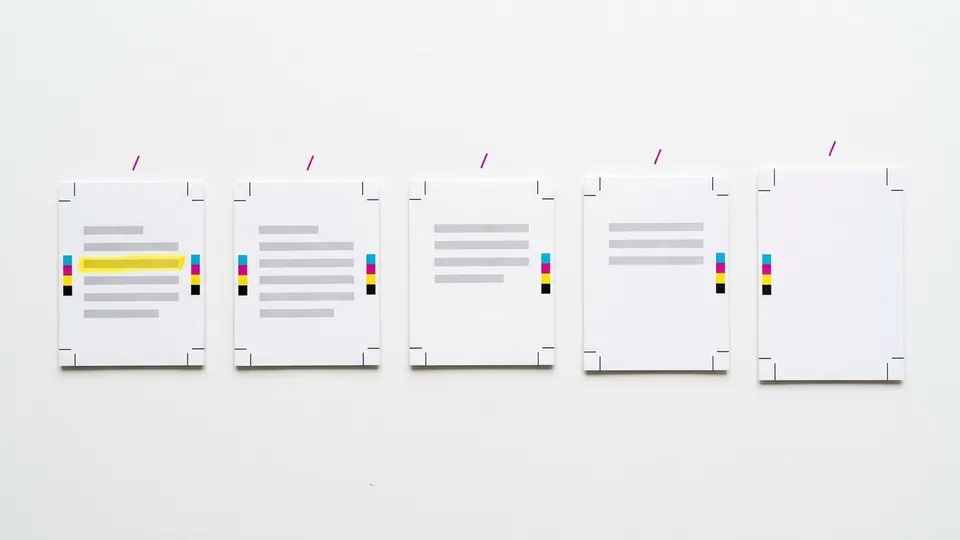
Take a fixed amount of study time, say one hour on a list of terms. You can use it in one block (massed practice) or split it into shorter sessions on different days (spaced or distributed practice). Spaced repetition is the second choice, made on purpose and on a schedule.
Two words in the research are worth knowing. The gap, or interstudy interval, is the time between two study sessions. The retention interval, or test delay, is the time between your last session and the test. Most of what the research says about scheduling is about how those two numbers relate.
Spaced repetition works best when each review is a retrieval: you answer from memory, then check. That is active recall, the practice of testing yourself instead of rereading. Spacing decides when you review; recall decides how.
The spacing effect: what the research found
Cepeda and colleagues, 2006: the meta-analysis
Nicholas Cepeda, Harold Pashler, Edward Vul, John Wixted and Doug Rohrer pulled the field together in a 2006 review in Psychological Bulletin, “Distributed practice in verbal recall tasks: A review and quantitative synthesis”. Its abstract reports 839 assessments of distributed practice in 317 experiments located in 184 articles. The authors examined spacing (consecutive massed presentations versus spaced learning episodes) and lag (less spaced versus more spaced episodes).
The central finding, in the abstract's words: the gap between sessions and the retention interval operate jointly to affect final-test retention, and the gap producing maximal retention increased as the retention interval increased. Put simply, there is no single best gap. The right gap depends on how long you need to remember the material.
Cepeda and colleagues, 2008: the optimal gap
A follow-up study in Psychological Science, “Spacing effects in learning: a temporal ridgeline of optimal retention”, measured this over long periods. More than 1,350 people were taught a set of facts, given a review after a gap of up to 3.5 months, and tested after a further delay of up to 1 year.
The abstract reports that at any given test delay, lengthening the gap at first increased and then gradually reduced final test performance. The optimal gap increased as the test delay increased. Measured as a proportion of the test delay, though, the optimal gap declined from about 20 to 40% of a 1-week test delay to about 5 to 10% of a 1-year test delay. The authors conclude that the interaction of gap and test delay implies that many educational practices are highly inefficient.
| Time until the test | Best gap, as the 2008 abstract states it | In days (calculated for this page) |
|---|---|---|
| 1 week | About 20 to 40% of the test delay | About 1.5 to 3 days |
| 1 year | About 5 to 10% of the test delay | About 18 to 37 days |
Dunlosky and colleagues, 2013: the utility rating
John Dunlosky and four coauthors rated 10 study techniques in a 2013 monograph, “Improving Students' Learning With Effective Learning Techniques”. Its abstract says practice testing and distributed practice received high utility assessments because they benefit learners of different ages and abilities and have been shown to boost students' performance across many criterion tasks and even in educational contexts. Five techniques, including highlighting and rereading, received a low utility assessment.
How to build a spaced repetition schedule for an exam date
The 2008 study tested one review after one gap. A real course needs several reviews, so the steps below are a practical reading of its main point: short gaps when the exam is close, longer gaps when it is far away, and never zero gaps. They are method advice, not figures from the paper.
Write the exam date at the top
Count the days from today. That number is your test delay, and it sets the size of every gap.
Learn the material once, properly
The first session is for understanding. Take notes and highlight the lines you expect to be tested on.
Set the first gap from the table
For an exam a week away, review again after about two days. For a final months away, the first review can wait a week or more.
Review by recall, not rereading
Close the book and answer questions on the material. Check each answer and mark what you missed.
Shorten gaps for misses, lengthen them for hits
An item you missed comes back next session. An item you answered well can wait longer before you see it again.
End with a review a day or two before the exam
A final light pass over the items you missed most. No new material.
Flashcards and paper schedules
Flashcard apps that use spaced repetition do the scheduling for you: you rate each answer and the app chooses when to show the card again. A paper version works on the same principle and needs only cards and a few labeled boxes or envelopes. The best-known paper form is often called the Leitner system.
| Box | When you review it | What moves a card |
|---|---|---|
| 1 | Every study session | Answered correctly: move to box 2. Missed: stays in box 1. |
| 2 | Every second or third session | Correct: move to box 3. Missed: back to box 1. |
| 3 | About once a week | Correct: move to box 4. Missed: back to box 1. |
| 4 | Once or twice before the exam | Correct: retire it. Missed: back to box 1. |
The intervals in the table are a starting point. The research gives the direction, longer gaps for longer retention, not an exact rule for each box. If your exam is a week away, box 3 might be every third day instead of weekly.
How highlights become review items
Highlighting on its own is one of the techniques the Dunlosky review rated low utility; the reasons are set out in the page on whether highlighting helps you learn. A highlight becomes useful once it turns into a question you will answer later, on a schedule.
- One highlight, one question. Write a question whose answer is the marked line, in your own words, on a card or in the margin.
- Date the question. Note the day you wrote it and the day it is next due.
- Keep the source. Add the page or a link so you can check your answer against the original.
- Use the cue column. If you take notes in the Cornell format, with questions in the left column, those cues are ready-made review items. Cover the notes and answer them on each review day.
A worked example: a biology quiz in seven days
Suppose your quiz is next Monday and you read the chapter today, Monday. The plan and the card below are written for this page as examples.
The plan uses about the same total time as one long Sunday-night session, spread over four days. Every review is a recall test, and the cards you know drop out, so later sessions get shorter.
Pitfalls with spaced repetition
- Gaps of zero. Reviewing the same card three times in a row is massed practice with extra steps.
- Rereading on review days. Looking over notes feels like review; answering from memory is review.
- Too many cards. A deck that grows faster than you can review it gets abandoned. Card only what will be tested.
- Starting too late. Spacing needs days. With one evening left, there is nothing to space.
- Judging by comfort. A spaced session feels harder because you have partly forgotten. That effort is the point.
Tips for spacing your review
- Put review days in your calendar the day you first learn the material.
- Keep sessions short. Fifteen minutes of recall on schedule beats an hour you skip.
Spaced repetition asks for no extra study time, only a different calendar. Learn the material once, review it from memory after a gap sized to the exam date, bring back what you missed sooner and what you knew later, and stop adding material in the last day or two. More methods for reading and remembering are in the study guides on reading, notes and review.
Common questions
What is spaced repetition?
Spaced repetition is a study method in which you review the same material several times, with gaps of days or weeks between sessions, instead of in one sitting. The benefit for long-term memory is called the spacing effect. It works best when each review asks you to recall the answer from memory before you check it.
What is the spacing effect?
The spacing effect is the finding that study spread over separate sessions leads to better retention than the same amount of study massed together. The 2006 meta-analysis by Cepeda and colleagues drew on 839 assessments in 317 experiments and found that the best gap between sessions grows as the time until the final test grows.
How long should I wait between review sessions?
It depends on when the test is. Cepeda and colleagues (2008) found the best gap was about 20 to 40% of the delay for a test one week away, and about 5 to 10% for a test one year away. For an exam a week off, that means a first review after roughly two days.
Is spaced repetition the same as distributed practice?
Yes, in practice. Distributed practice is the research term for spreading study over separate sessions; spaced repetition usually means doing that on a deliberate schedule, often with flashcards. The 2013 Dunlosky review rated distributed practice as one of two high utility techniques, alongside practice testing.
Do I need an app for spaced repetition?
No. Apps automate the scheduling, but a paper system of cards and labeled boxes does the same job: correct cards move to a box you review less often, missed cards go back to the first box. What matters is that gaps grow for items you know and that every review is a recall test.
Can I use spaced repetition if my exam is tomorrow?
Only a little. Spacing needs time between sessions, so with one day left there is little to space. Review the most important items twice, once now and once a few hours later, and sleep. For the next exam, start the schedule the day you first learn the material.
Sources
- Cepeda, N. J., Pashler, H., Vul, E., Wixted, J. T., and Rohrer, D. (2006). Distributed practice in verbal recall tasks: A review and quantitative synthesis. Psychological Bulletin, 132(3), 354 to 380 (PubMed abstract)
- Cepeda, N. J., Vul, E., Rohrer, D., Wixted, J. T., and Pashler, H. (2008). Spacing effects in learning: a temporal ridgeline of optimal retention. Psychological Science, 19(11), 1095 to 1102 (PubMed abstract)
- Dunlosky, J., Rawson, K. A., Marsh, E. J., Nathan, M. J., and Willingham, D. T. (2013). Improving Students' Learning With Effective Learning Techniques. Psychological Science in the Public Interest, 14(1), 4 to 58 (PubMed abstract)
sign-off
Checked against its sources and signed before it went out.
Nora Feld
Editor · reviewed 10 Nov 2026